Search results
Women, Peace and Security in the Age of AI and Emerging Technologies: A spotlight interview with Rana Elbeheiry
On 31 October 2000, the UN Security Council made history: Resolution 1325 became the first official framework to recognize that peace cannot be built and sustained without women. This landmark resolution launched the Women, Peace and Security (WPS) agenda and changed the way the world thinks about conflict and peace.
Twenty-six years later, the world and its digital spaces are no longer the same. Emerging technologies are redrawing the security landscape, and the stakes for women have never been higher. The same tools that can amplify women’s voices can also silence them. Online harassment, disinformation, deepfakes and biased algorithms threaten to push women out of the spaces where peace is made.
So, what does the WPS agenda need to stay fit for the future?
This is not a task for the future; it is work that needs to happen now. At the Peace & Security Hub, this work has already begun.
Our workshop on the margins of the AI Summit in Paris brought together practitioners, researchers and peacebuilders to explore how emerging technologies can be used to advance, rather than undermine, women’s participation in peace and security. The insights and solutions that emerged from these discussions are captured in our report, “The AI Peace Nexus - Elevating WPS Agenda in Yemen’s Digital Future”, which offers concrete recommendations for practitioners and policymakers working on WPS.
Building on this, we have developed a training module on Gender Bias in Generative AI. It equips UN staff and peace and security actors with the knowledge and tools to recognize bias in AI systems and to use these technologies in ways that are ethical, responsible, and inclusive... Read more about the course and enrol here.
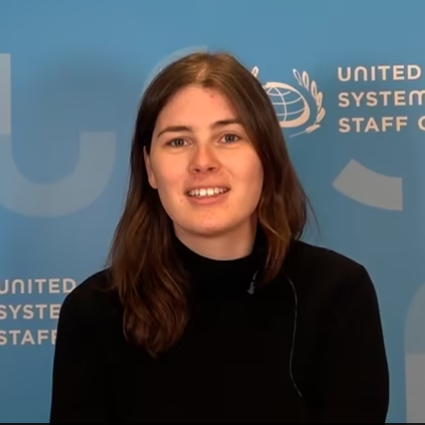
In this spotlight interview, Rana Elbeheiry, Associate Learning Officer, and Eira Fallen, Learning Portfolio Manager at the UNSSC’s Peace and Security Hub, revisit the agenda 26 years after its adoption. They explore how emerging technologies intersect with WPS, highlight gaps in the agenda, and explain why it must adapt to today’s digital realities.
Eira: Why is the intersection between emerging technologies and the Women, Peace and Security (WPS) Agenda relevant today? Why is it necessary to look at this intersection?
Rana: I think it's becoming more and more important to think about conflict in a broader sense. Conflicts are no longer experienced only in the physical space; they are being digitalized. The way conflict is experienced, the way it manifests, and even the way it is broadcast in front of all of us in different contexts. It is not just about conflict in the physical and direct sense, but also about how it is taking another form and another shape.
The Women, Peace and Security Agenda is currently lagging behind emerging technologies in recognizing both the challenges and opportunities presented by artificial intelligence. It is important to address AI and the Women, Peace and Security agenda together, rather than separately.
Because if we think about it, who experiences this the most? Women peacebuilders and women human rights defenders are most directly affected by these issues. Evidence shows that deepfakes, online harassment, and smear campaigns disproportionately target women.
Why are they targeting women? To silence them. It is another way to actually put an X on women's participation. It is expected that women join peace processes. It's expected that women are active actors in this space. But at the same time, if their credibility is undermined, or if there is social backlash or stigma, this will limit their effective and impactful participation.
So, it's really necessary to talk about this intersection right now. There are no existing legal or protection frameworks at the moment. Excluding women, especially those in conflict and fragility-affected settings, risks missing the opportunity to ensure their participation in these emerging areas.
Eira: 31 October 2025 marked the 25th anniversary of the WPS agenda, as well as the beginning of UNSSC’s work exploring this intersection. Our first activity in this regard was a workshop that we organized at the margins of the AI Summit in Paris.
Rana: I was very excited to finally try to bridge the gap in this workshop, and to finally have Women, Peace and Security practitioners like myself and AI experts speak together. It wasn't an easy conversation in the beginning, but by the end of the workshop we managed to speak the same language, or to translate our terminologies and languages so that practitioners of the WPS agenda can understand them, and vice versa.
The most challenging aspect was translating AI concepts and language together with AI and ethics experts to make them accessible to women peacebuilders. And this is what the workshop was mainly about: bringing together Yemeni women peacebuilders, human rights defenders and political actors, who are most affected by the risks of digital spaces, emerging technologies and AI. This was the collaborative environment we aimed to create.
We tried to embed it in the pillars of the agenda. We tried to think about the risks for each pillar, but also about how we can leverage AI and emerging technologies to support us in advancing these pillars in the Yemeni context. Drawing on the experiences of the women peacebuilders and the people in the room, we created a space for critical reflection and solutions, and, more importantly, with a focus on applying these insights to conflict-affected settings.
Eira: Zooming out of the Yemeni context, what lessons from this project could also be relevant in other contexts?
Rana: That AI, WPS and emerging technologies are not exclusive to AI experts. What was very clear in this workshop and this experience is that it's not an exclusive space. We may not speak the same language, but we can translate complex messages across the different intersections.
Local peacebuilders and women need to be at the table. Otherwise, emerging technologies and AI perpetuate existing biases and stereotypes leading to more harm than good.
The issue is that large language models currently derive their data from what exists online, right? And what exists online is limited and very exclusive in terms of languages and the kind of data that is available. Local realities are not necessarily translated into the online space. The data coming into large language models does not necessarily represent what is happening on the ground.
As long as this gap exists, stereotypes will continue to exist, and biases will also continue to exist.
Eira: Looking at this from a learning and capacity perspective, what concrete actions can we take to help peace and security actors, practitioners and UN staff engage with AI in ways that are ethical, inclusive and conflict-sensitive?
Rana: As a learning institution, our entry point and starting point is raising awareness: raising awareness of the implications of the use of AI for the Women, Peace and Security agenda, in their contexts and even beyond.
A second thing we can do is create learning experiences that are contextualized and localized to specific contexts, enabling community members to analyze the Women, Peace and Security pillars and identify both risks and opportunities related to emerging technologies and AI.